






 Condividi
The façade defines the identity of the home and anticipates its character, connecting architecture, landscape, and lifestyle.
Among the most versatile exterior façade coverings, porcelain stoneware allows you to reinterpret stone, concrete, wood, and terracotta looks with a contemporary language. Thanks to its variety of sizes, textures, and tones, it can cover the entire façade or highlight specific elements, such as the entrance, base, porch, and projecting volumes, creating continuity with terraces, flooring, and garden.
Let’s look at how to design a balanced modern façade, which materials and colors to choose, and which Ragno collections can help define the home’s outdoor spaces.
How to Design a Modern and Balanced Façade
An effective façade doesn’t result from the random combination of materials. The best ideas for modern home façades start with analyzing the architecture and assign each surface a specific function: lightening a volume, highlighting the entrance, creating continuity with the landscape, or defining contrast.
Before choosing the covering, it’s important to evaluate the building’s shape, orientation, placement of openings, and relationship with the outdoor spaces. Natural light also influences the perception of surfaces: colors and textures may change appearance during the day and according to exposure.
In homes with clean lines, large uniform areas, refined palettes, and a few well-coordinated materials help create a harmonious whole. In more complex buildings, on the other hand, the covering can help distinguish different volumes and clarify the architectural composition.


Cover the Whole Façade or Only Some Parts?
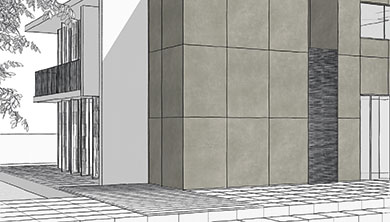
Full coverage creates a compact look, especially suited to minimalist homes or monolithic volumes. A partial installation, on the other hand, offers more creative freedom and allows you to focus attention on the building’s most important points.
You can cover only the base to give greater visual solidity, emphasize the entrance portal, or distinguish the upper floor with a different finish. In many cases, the most harmonious solution is to use two main materials and an accent, avoiding breaking up the façade with too many colors or textures.
A textured covering can, for example, highlight the entrance volume, while a more uniform surface can define the rest of the building.
Creating Continuity Between Indoors and Outdoors
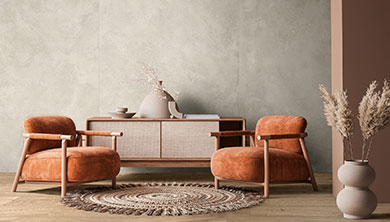
Continuity between indoors and outdoors comes from referencing colors, textures, and material effects that connect the living room, porch, terrace, and façade. This dialogue makes the transition between house and garden feel more natural and helps give cohesion to the entire project.
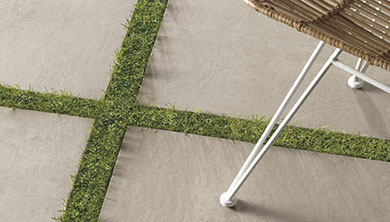
Coordinated collections let you adapt surfaces and finishes to different uses while maintaining a consistent aesthetic style. The effect can be quite subtle: a stone-look floor, for example, can connect with an exterior wall in the same tone, but in a different size or texture.
Why Choose Porcelain Stoneware for Exterior Façades
Porcelain stoneware is a particularly versatile solution for façade coverings because it combines technical performance with aesthetic research.
Depending on the chosen collection, porcelain stoneware can offer frost resistance, easy cleaning, color stability, and a wide range of sizes. It also allows you to design coordinated surfaces, enhancing looks inspired by stone, wood, concrete, and terracotta without sacrificing overall consistency for the building.
Ceramic coverings contribute to the protection and aesthetic definition of the building envelope, but do not replace a thermal insulation system. Aspects such as layering, waterproofing, thermal bridges, and energy performance must therefore be designed separately and entrusted to qualified professionals.
Modern Façade Ideas: Stone, Concrete, Wood, and Terracotta
The material look plays a decisive role in defining the character of the façade and the overall perception of the building.
Stone Look for a Natural and Contemporary Architecture
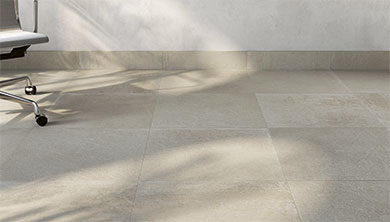
The stone look is ideal for those who want a modern home that fits well into the landscape: sand, beige, and warm gray tones soften the volumes; darker shades can highlight entrances, bases, and recesses.
The Realstone_Argent collection interprets stone with a balanced and contemporary surface, suitable for projects seeking continuity between indoors and outdoors.
For a different material intensity, consider Eterna, Creek, and Realstone PietrAntica: Eterna suits projects focused on a natural and coordinated aesthetic, Creek echoes limestone shades, while Realstone PietrAntica offers a more intense and textured character.
Concrete Look for Essential Façades
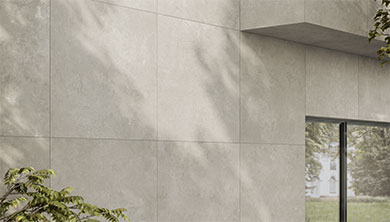
The concrete look enhances homes with clean geometries, with flat roofs, overlapping volumes, and large openings. Light gray, taupe, and anthracite tones help create a sober, urban image, perfect for minimal living spaces or commercial spaces with a modern feel.
To warm up the result, the concrete look can be paired with wood, greenery, and warm lighting: it’s effective on a main volume or in the coordination of façade, walls, and outdoor pathways.
A light surface helps lighten the building, while a deeper tone can highlight the upper floor or a projecting body. The concrete look also lends itself to tone-on-tone combinations, where the difference comes more from texture than color.
Wood Look to Add Warmth
Among the most modern solutions, the Nodis collection offers porcelain stoneware wood-look tiles for indoor and outdoor use, ideal for creating continuity between living spaces and outdoor areas.
In a modern façade, it’s best to focus the wood look on selected areas: covering the entrance, attic, or a porch wall adds warmth without changing the overall clean lines of the volumes.
Small Size and Terracotta Look
If the wood look introduces warmth through continuous surfaces and natural grain, the terracotta look creates a more decorative, rhythmic result while still maintaining a connection to the material and earth tones.
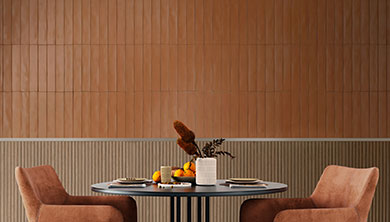
Using small sizes can also transform part of the façade into a signature feature. Reimagined through regular joints, clean geometries, and simple pairings, the terracotta look in small sizes moves beyond its traditional image and takes on a contemporary character.

The Solida collection can enhance entrances, niches, bases, and protected porch walls, creating a warm, textured accent. To keep the look balanced, it’s best to pair it with uniform surfaces and neutral tones, letting the covering stand out without overwhelming the composition.
The decorative power of small sizes requires careful use: applied to a limited surface, it generates movement and personality; used everywhere without a clear hierarchy, it can make the façade look visually fragmented.
How to Choose Colors for a Modern Façade
Color changes the perception of proportions. Light shades, like warm white, ivory, sand, and soft gray, make volumes brighter and are easy to coordinate with stone, wood, and greenery.
Dark colors, such as graphite and anthracite, define geometries and add depth, but should be considered in relation to sun exposure and climate. They can be used to highlight bases, recesses, or upper floors, without weighing down the entire building.
A balanced palette can be built with a dominant color, a secondary tone, and an accent. Tone-on-tone creates an elegant, subtle effect; light-dark contrast, on the other hand, gives a more graphic façade.


Sizes, Joints, and Installation: The Details That Define the Result
Once you’ve chosen the material effect and color palette, the façade design is defined through sizes, joints, and installation patterns.
Large sizes reduce the presence of joints and create more continuous surfaces, particularly suited to essential, contemporary architecture. Smaller modules add movement and depth, enhancing entrances, niches, and decorative sections.
The direction of installation also helps change the perception of the building: a vertical layout tends to elongate the façade, while a horizontal layout visually expands the wall. The color of the joints can support this choice, making the surface more uniform or highlighting the modular design.
A tone-on-tone joint reinforces the continuity of the covering, while a contrasting solution highlights its geometry. In both cases, the joint should be considered an integral part of the design, not just a technical detail.
The quality of the result ultimately depends on correct design and execution. Before installation, you need to check suitability for outdoor use, frost resistance, size, weight, substrate flatness, fastening system, joints, connections, and installation products.
Façade Maintenance and Durability
Porcelain stoneware is generally associated with low maintenance, but façades still require regular inspections to maintain their aesthetic quality and performance over time. Cleaning the surfaces, checking joints and seals, and inspecting the most water-exposed areas all help preserve the covering.
Maintenance isn’t just about ceramic material. Joints, corners, sills, coping, and connection points must also be checked regularly, since they contribute to the overall protection of the envelope and the façade’s durability.
A Modern Façade in Harmony with the Home’s Style
A successful façade comes from the intersection of aesthetic quality, performance, and proper design. The stone look connects with the landscape, concrete emphasizes geometries, wood adds warmth, and small sizes create rhythm.
Porcelain stoneware offers numerous compositional possibilities, but the choice should start from the building’s actual characteristics and the suitability of each specific surface. Colors, sizes, and textures should be considered parts of a single project, not isolated elements.
Explore the Ragno collections to find materials and effects capable of interpreting the home’s architecture and building a consistent dialogue between interior, façade, and outdoor spaces.