







 Condividi
At what height should you stop the bathroom wall tile? This question involves a decision that often affects the look of the space as much as the color, tile size, or furniture layout.
You can choose a half-wall installation, stop at the height of the door, or continue all the way to the ceiling. There isn’t a single ideal height that works for every project: the best solution depends on the proportions of the room, the areas most exposed to water, and the aesthetic result you want to achieve.
As a reference, you can consider about 47-59 inches for half-height, 79-87 inches for a height near the door, and the entire wall for a floor-to-ceiling installation.
Let’s take a look at how these three solutions differ and what aspects to consider when choosing the best height for your bathroom.
Half wall, door height or ceiling: what’s the real difference?
Changing the height of the wall tile means changing the perception of the wall.
A ceramic band leaves more room for paint and color; going up to the door, the surface gains more continuity; reaching the ceiling, ceramic instead becomes one of the dominant features of the project.
Half-height bathroom wall tile
With half-height bathroom tile, the tiles typically cover the lower part of the wall, while the upper part can be painted or finished with a different surface.
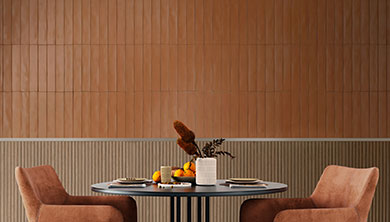
An indicative height between 47 and 59 inches creates an effect similar to ceramic wainscoting, linking different materials, colors, and surfaces.
This is a particularly interesting solution on walls less exposed to water, where the contrast between ceramic and paint can become an integral part of the interior design.
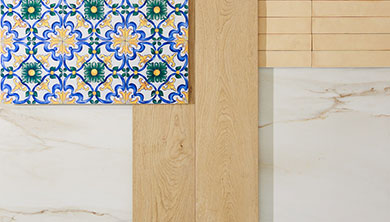
Ragno collections featuring decorative surfaces, small sizes, or rich textures can help enhance this wall division. Collections like Look, for example, let you create bold color fields for strong visual impact, while solutions with a more natural look provide a smoother transition between the tiled area and the painted wall.
The point where the tiles end should be carefully defined: the line where the tile stops becomes a design element itself.

Tile up to the height of the door
Stopping the tile near the door’s lintel creates a middle ground between half-wall and floor-to-ceiling.
Generally, this means a height around 79-87 inches, but it’s not the measurement that determines the result: the main advantage is the ability to use an existing architectural element as a visual reference.
Door, windows, niches or mirrors can help create a consistent height, avoiding an apparently random stopping point. In a bathroom with clean lines, continuous ceramic surfaces reinforce this sense of order.
Bathroom wall tile up to the ceiling
When the tiles reach the ceiling, the wall becomes a continuous surface and the ceramic material takes on a stronger presence.
This is a natural choice in areas most exposed to water and moisture, such as the shower or tub wall, but it can be used throughout the bathroom for a more immersive, contemporary effect.
Marble- or stone-effect surfaces, for example, can enhance a continuous wall by turning it into an elegant backdrop. Ragno collections like Incanto or lines from the Realstone series are worth considering when you want to highlight the material and veining.

Where should you stop the tiles in the bathroom? First, look at the features already present
Before deciding where to stop the tiles in the bathroom, it’s helpful to look at the entire wall as a whole.
A door can suggest a height; a window can create a second alignment; near the vanity, the cabinet and mirror define a vertical and horizontal composition the tile needs to relate to. The same goes for niches, shelves, and shower enclosures.
A height works best when it seems to emerge from the room’s geometry, rather than clashing with it.
Sink, shower, and tub areas don’t all have to have the same height
It’s not essential to tile the whole bathroom at the same height: the shower area, which is more directly exposed to water, can be tiled up to the ceiling.
The wall behind the sink can stop lower, or be designed in relation to the mirror. Around the tub, the tile can serve both a functional and decorative purpose.

In a small bathroom, is it better to use half-wall tile or go up to the ceiling?
In a smaller bathroom, the tile height can significantly change how the walls are perceived, but there’s no automatically preferable solution.
- Half-wall tile creates a separation between ceramic and paint and is useful if you want to play with two colors or finishes.
- Tiling up to the ceiling, on the other hand, minimizes breaks between materials and can give the wall a more uniform look.
Other things also make a difference: light or bold colors, matte or glossy surfaces, installation pattern, amount of grout lines, and lighting.
In a small space, it’s more useful to think about the overall balance of the wall than to rely on a single rule.
Tile size and installation pattern can help you decide the tile height
The size of the tiles also directly affects the height you choose.
With large formats, the number of grout lines is reduced and the surface appears more seamless: a feature that can be especially effective on walls tiled to the ceiling.

Smaller sizes, on the other hand, add rhythm and let you create decorative bands, color blocks, and details.
Orientation also changes how you perceive the proportions: a vertical layout can emphasize height, while a horizontal composition emphasizes the width of the surface.
When choosing, it’s helpful to look at the full range of Ragno wall tiles, comparing sizes, effects, and finishes to match the real dimensions of your bathroom.


Can you use different heights in the same bathroom?
Yes, using different heights can be an effective design choice, especially when different walls serve different purposes.
The shower can go all the way to the ceiling, while a side wall can stop at half-height. The vanity area can become its own ceramic backdrop or be visually connected to other surfaces using the same color or material.
It’s not necessary to make all the walls the same; what’s important is that the different choices belong to the same design concept.
A Ragno collection available in various sizes or finishes can make this kind of composition easier, letting you vary rhythm and height while keeping material continuity.
How to choose the final height for your bathroom wall tile
The final height comes from a balance between practical needs and the composition of the room. Walls most exposed to water may need more extensive tiling, while doors, windows, mirrors, and cabinets provide useful reference lines for finding a harmonious height. The relationship between ceramic and paint also contributes to the result: a continuous surface gives a more uniform look, while a partially tiled wall lets you play with different materials and colors.
Completing the project is the tile size, which should be related to the size of the wall to achieve balanced grout lines, cuts, and proportions. Half-wall, door height, and ceiling are three options, not rules: the best solution is the one that combines function, proportions, light, furnishings, and materials.
Discover the Ragno collections designed for bathrooms and find surfaces, sizes, and finishes to design the wall tile best suited for your space.
